


By:
Fr. Michael A. Banjo
Secretary General
Catholic Secretariat of Nigeria
At Nigeria’s independence on 1 October 1960, Sir Abubakar Tafawa Balewa declared confidently that “Nigeria now stands well-built upon firm foundations.” Five years later, Dr Nnamdi Azikiwe identified a crack within those foundations, observing that many Nigerians still regarded themselves “as aliens in our own country and strangers among our own peoples.” Sixty-six years after independence, these two statements confront us with a searching question: have we truly learnt to belong to one another?
We share a territory, a Constitution, common symbols and public institutions. Yet our loyalties too often stop at the boundaries of ethnicity, religion or region. We speak readily of “our people”, but that expression frequently excludes millions of other Nigerians. We condemn injustice when our group is affected but may become silent when the victims belong to another community. Nigeria’s deepest challenge is not diversity itself, but our failure to develop a sense of belonging strong enough to hold our differences together.
Belonging Remembered, Belonging Denied
I first encountered this culture of belonging not in a textbook, but in childhood. My closest friends included Etekamba, Obi, Debo, Gbenga, Dambo, Saheed, Mojeed and Agbeyegbe. We came from different ethnic, religious and social backgrounds, but none of that determined our friendship. What mattered was that life had brought us together, and we accepted one another simply as friends. I did not encounter the language of religious bigotry or tribalism until much later. Our differences were real, but they were never barriers to belonging.
That childhood experience reflects the African insight of Ubuntu: “I am because we are.” It teaches that our dignity, security and flourishing are interconnected. But Ubuntu cannot remain a cherished childhood memory or an attractive cultural slogan; it must become a public ethic, expressed through justice, dialogue, mutual respect and commitment to the common good.
Regrettably, much of our public life denies this shared belonging. Competence and integrity are sacrificed to sectional interests. Nigerians who have lived, worked and paid taxes in a place for decades are still treated as strangers because they are labelled “non-indigenes”. Even compassion is divided along ethnic and religious lines, as the identity of victims determines whether their suffering receives our concern. We cannot claim the spirit of family while excluding some members, denying them justice and then asking them to accept their condition in the name of peace.
The consequences are visible in the insecurity, economic hardship and distrust that burden our people. Families mourn victims of violence, communities are displaced, and many Nigerians struggle to afford food, education and healthcare. Corruption and sectional favouritism deepen these hardships by diverting resources and opportunities from the common good. These problems may appear political or economic, but they also reveal a deeper moral failure: we have not sufficiently learnt to regard the life, dignity and welfare of every Nigerian as our shared responsibility.
The Culture of Family: Unity without Uniformity
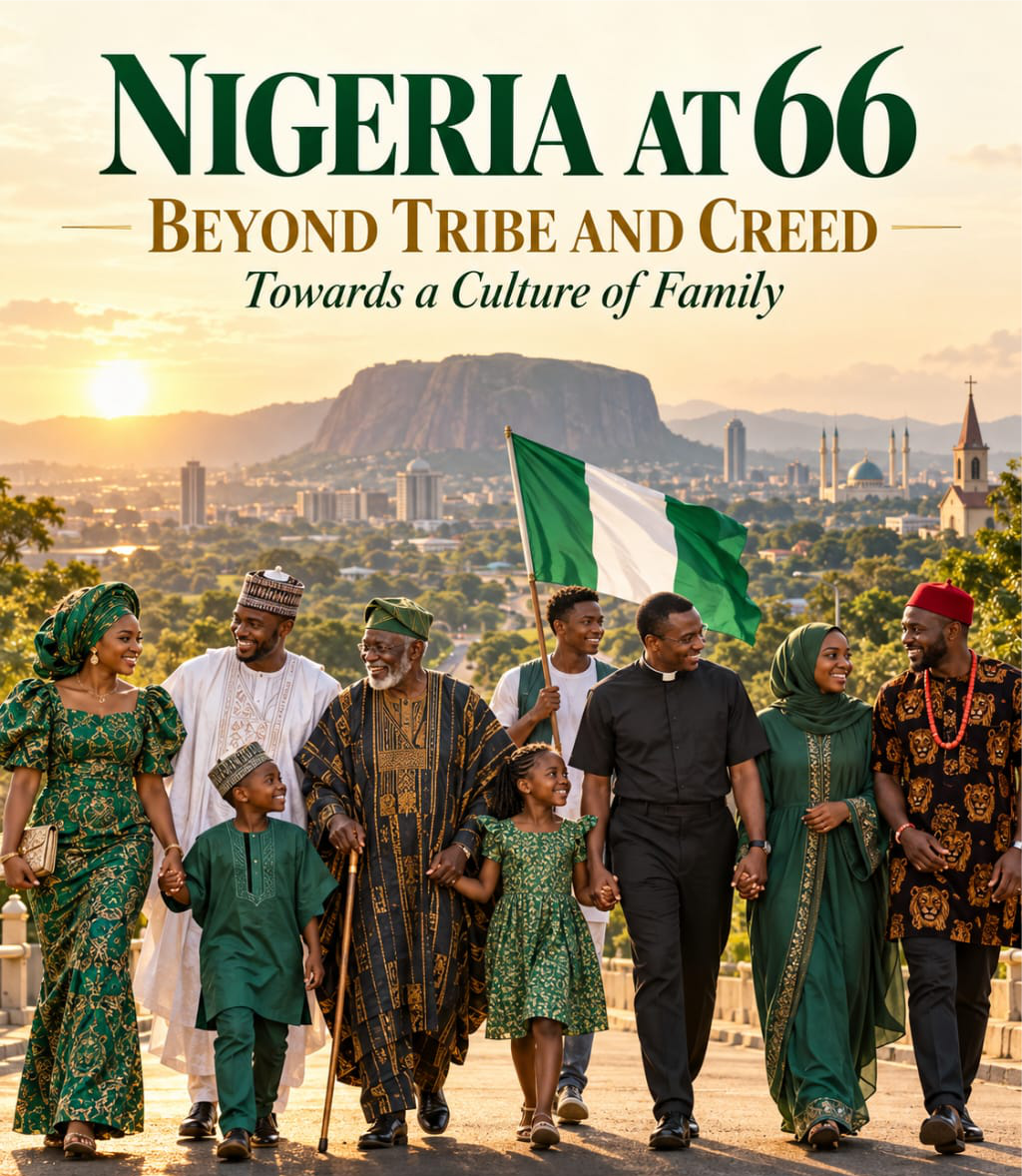
How, then, do we move from selective belonging to a common life in which every Nigerian has a place? The answer begins with the family. Although Nigeria’s ethnic cultures and religious traditions differ, the values that sustain every healthy family are remarkably similar: respect for life, love, acceptance, forgiveness, sacrifice, responsibility and concern for the weak. Family members may differ in age, temperament, ability and opinion, but those differences neither diminish their dignity nor cancel their belonging. This model does not require Nigerians to surrender their distinct identities. Chief Obafemi Awolowo captured the point when he observed: “You can unite but can never succeed in unifying peoples whom language has set distinctly apart from one another.” Unity brings different peoples together around a common good; uniformity seeks sameness by suppressing their differences. Nigeria needs the former, not the latter. Like a healthy family, it must hold its diverse members together through justice, mutual respect and shared responsibility, without erasing what makes each distinct.
One concrete expression of this unity without uniformity is respect for religious freedom, which allows Nigerians of different faiths to belong fully without surrendering their religious identity. I experienced this harmony growing up in western Nigeria, where Christians and Muslims lived together, respected one another’s faith and shared in community life without anyone being made to feel that he or she belonged less. That spirit still exists in many parts of Nigeria, even as religious exclusion persists elsewhere. How beautiful it would be if it became the experience of every Nigerian, so that Christians in predominantly Muslim communities and Muslims in predominantly Christian communities could freely establish places of worship, practise their faith, participate in public life and receive equal protection. When we defend the freedom of others as conscientiously as we defend our own, we affirm our common humanity and strengthen the family spirit on which a peaceful and united Nigeria must rest.
What is true of religious freedom must extend to the whole of our public life. Unity becomes durable only when it shapes how we treat one another and organise our common life. Extending the culture of family to Nigeria means ensuring that security, justice, opportunity and public service do not depend on ethnic, religious or regional identity. This requires translating the values we cherish within the family into practical commitments in society: respect for life, by protecting the life and dignity of every person; love, by caring about the welfare of others regardless of their background; sacrifice, by giving up unfair advantages so that others may also have a fair opportunity; forgiveness, by refusing to allow past wrongs to fuel endless resentment and retaliation; responsibility, by refusing to remain indifferent when another Nigerian suffers injustice; and accountability, by confronting wrongdoing rather than concealing it in the name of unity. Only when these values move from our homes into our institutions can Nigeria become a truly peaceful and united country.
Patriotism as Responsibility for One Another
This is the patriotism Nigeria requires: not merely affection for the flag, enthusiasm for the anthem or support for those in power, but an unwavering commitment to the dignity and welfare of every Nigerian. It refuses to excuse injustice because the offender is “one of us” and recognises that no group can build lasting peace or prosperity upon the exclusion of another.
The challenge, therefore, is shared. Every Nigerian must make the culture of family visible in daily life: refusing ethnic and religious insults, treating others fairly, rejecting favouritism, assisting victims without first asking where they come from, and speaking against injustice even when the offender belongs to one’s own group.
Government must make equal citizenship a lived reality by protecting every life, safeguarding religious freedom, ensuring fair access to opportunities and holding perpetrators of injustice accountable. Employers must provide fair wages and humane working conditions, while wealthy Nigerians must use their resources to create opportunities and support those in need. Religious leaders must reject inflammatory preaching and defend the rights of those outside their own faith communities. Traditional rulers and community leaders must ensure that no resident is treated as a stranger. As the 2027 elections approach, the electorate must rise above sectional loyalties and judge candidates by their character, competence, record and commitment to the common good. Educators and the media must resist divisive narratives and promote human dignity, equal belonging and the common good. The culture of family must shape not only our personal relationships, but also the institutions, resources and voices that form our common life.
Nigeria will not be rebuilt by laws, institutions and symbols alone. It will be rebuilt when another Nigerian’s pain becomes our concern, another’s dignity becomes our duty and the common good becomes our shared inheritance. Independence gave us a country; the culture of family must teach us to belong to one another. When every Nigerian can say, “I belong here, and the good of others is also my responsibility,” we shall have moved beyond tribe and creed towards a peace strong enough to endure.
May God, through the intercession of Our Lady, Queen of Nigeria, heal our divisions and make us truly one. Amen.

