16
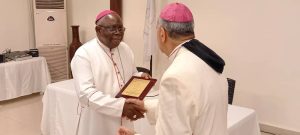
According to the Bishop of the Eastern Catholic Church, the event was targeted towards creating an awareness about the identity and presence of the Maronite Church within the Catholic Church community in Nigerian, consolidate the collaboration enjoyed with the Roman Catholic Church in Nigeria and particularly with Ibadan Archdiocese, and finally, to set goals for other modes of possible collaboration.
With the theme, “Walking together the synodal journey: when East and West meet in Africa”, the very interactive event entailed paper presentations by
Thus, the Maronites are Catholics, except that they are different from the Roman Catholic Latin Rite that Nigerians are used to; they belong to Eastern Catholic Church belonging to the Syriac Antiochene Tradition. They are also Chalcedonians because in the year 451, a delegation from the monastery of Beth-Maron participated at the council of Chalcedon and stood by the Pope in his teaching affirming the two natures of Jesus Christ, human and divine.
EAST & WEST Churches meet in Ibadan

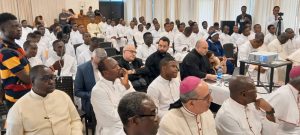
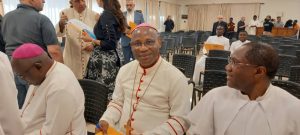 In his presentation, Bishop Faddoul traced the origin of the Maronite Church to the hermit called Maron who lived in the 4th century in Antioch, where the followers of Christ were first called Christians. Those who saw him as a spiritual father and followed him came to be known as the Maronites, and after his death, around the year 410AD, they built their first monastery called Beth-Maron (which means the house of Maron) in Apame. This community formed the nucleus of the Maronite Church. Thus, being Patriarchal with a Monastic spirituality is one of the defining elements of the Maronites; other elements are Antiochene (their origin from Antioch), Chalcedonian (participation in the council of Chalcedon), love and devotion to the See of Peter in Rome (loyalty to the Pope) and integrally tied to Lebanon (where they eventually found a home and thrived after so many persecutions and dispersions).
 This was a defining moment of the Maronites loyalty to the Pope to the present age; all through history, the Maronites have never fallen apart from the Pope.
 While the Patriarch has jurisdiction within a patriarchal territory, which for the Maronite Church include Lebanon and the Middle East (Egypt, Syria & Palestine), the Code of Canons of the Eastern Churches, reserves the right of establishing an eparchy and the appointment of eparchial bishops outside of the patriarchal territory to the Pope. Presently, the Maronite Church consist of 28 dioceses, with 18 within the Patriarchal zone (Lebanon, Syria, the Holy Land, Egypt and Cyprus), while 10 diocese are outside the Patriarchal zone in the Americas, Australia, Europe, and Africa.
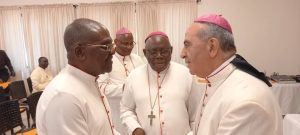
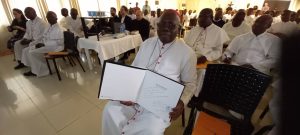 In his remark, the Archbishop of Ibadan, Most Rev. Gabriel Abegunrin expressed joy that the Maronites, the Eastern Catholic Church, are connected with the Catholic in Nigeria, the Western Catholic Church, through Ibadan Archdiocese, describing their presence as a truly enriching and a great blessing for the Archdiocese and for the entire Catholic Church in Nigeria. He was full of gratitude and praise for Bishop Faddoul whom he described as a fatherly and committed pastor with great initiative and zeal. On behalf of the Archdiocese, he reassured the Maronite community of total support and openness to collaboration though various pastoral initiatives, including catechesis, pastoral services and personnel exchange. He requested the Bishop to consider a repeat of the tour of the relic of St. Charbel to Nigeria and providing guidance on managing the relationship with the Muslim community, relying on their experience in the Eastern Church.