


By Fr. Leonard Ehiemere
The Catholic Secretariat of Nigeria (CSN) has called for stronger collaboration among dioceses, religious institutions, government agencies and development partners to ensure that internally displaced children across the country have access to quality education.
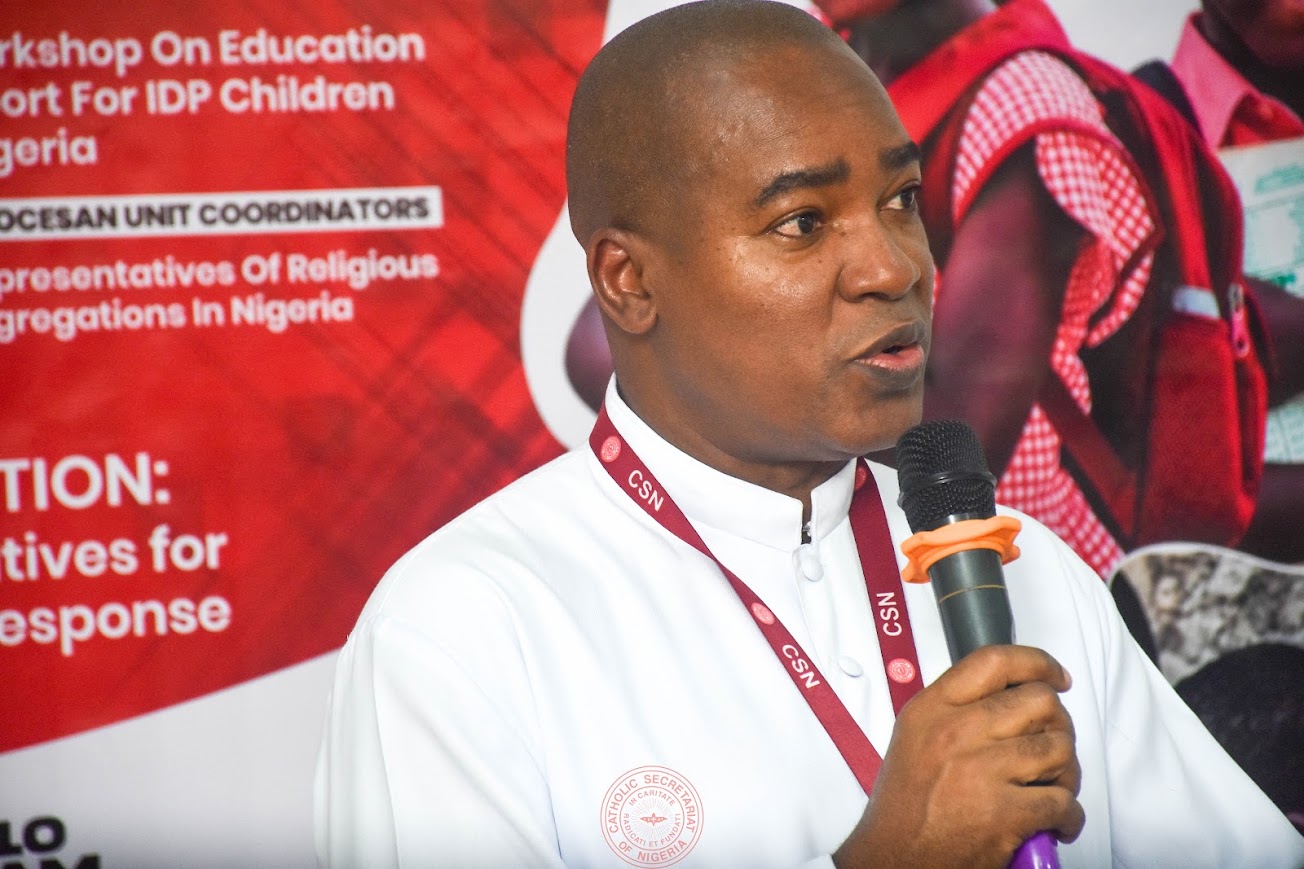
The Secretary General of the Secretariat, Rev. Fr. Michael Banjo, made the call on Wednesday, November 4, 2026, while delivering his welcome address at the National Workshop on IDP Children’s Education in Abuja.
Fr. Banjo expressed concern over the growing number of children whose education has been disrupted by insecurity and violence, noting that displacement exposes them not only to interrupted schooling but also to exploitation, trafficking and poverty.
He maintained that children who have been forced out of their homes should not be denied the opportunity to build a future through education.
“Education safeguards human dignity, creates opportunities and advances human development,” he said, describing access to education for vulnerable children as a moral responsibility of the Church rather than an act of charity.
Quoting Pope Leo XIV’s Apostolic Exhortation, Dilexi te, Fr.Banjo stressed that educating poor children was a duty rooted in the Christian faith and a recognition of their fundamental human dignity.
He urged participants to translate the Church’s teachings into practical interventions that would give displaced children the opportunity to learn, develop their abilities and contribute meaningfully to society.
Citing the work of Nigerian Chess master and founder of Chess in Slums Africa, Tunde Onakoya, the CSN Secretary General highlighted how targeted interventions could transform the lives of children from disadvantaged backgrounds.
He recalled how Onakoya took five children to the United States in 2025 to participate in international Chess events, including Ferdinand, a boy living with cerebral palsy, and Mary, whose family was displaced by Boko Haram violence.
According to him, their achievements demonstrate that difficult circumstances should not determine a child’s future when opportunities are provided.
“This is precisely the vision at the heart of our workshop: to identify and harness existing initiatives, strengthen what is working and extend opportunities to more children whose future is threatened by displacement,” he said.
Outlining practical measures for improving access to education, Banjo called on dioceses to identify displaced children within their communities and facilitate their enrolment in nearby public and Catholic schools.
He also urged parishes, religious congregations and benefactors to support affected families with school fees, uniforms, books and other learning materials.
Other interventions he identified include remedial classes for children who have missed years of schooling, specialised teacher training, counselling, mentorship, recreational activities and pastoral support to help children recover from the effects of displacement.
He further advocated livelihood support for displaced families, stressing that economic hardship should not force children out of school. He also called for stronger partnerships with government agencies and development organisations to establish sustainable educational opportunities.
The Secretary General commended coordinators of the Migrants and Refugees Unit across dioceses, Institutes of Consecrated Life and Societies of Apostolic Life for their continued commitment to displaced persons despite operational and financial challenges.
He equally acknowledged the contributions of the CSN Education Unit, Caritas Nigeria and the Jesuit Refugee Service, describing their collaboration and technical support as important to strengthening the Church’s response.
Fr. Banjo specially recognised the Chairman of the Migrants and Refugees Unit, Most Rev. Sylvester Gopep, for his guidance and commitment to the Unit’s work. He also appreciated the immediate past chairman and pioneer leader, Most Rev. Bulus Yohanna, for laying a strong foundation for the Unit during its formative years.
He reserved particular commendation for the Unit’s pioneer Secretary, Rev. Fr. Augustine Akhogba, whose three-year tenure, he said, had prioritised practical diocesan guidelines, institutional development and strategic partnerships.
Among the achievements he highlighted were the development of partnerships with government agencies and non-governmental organisations, the signing of a Memorandum of Understanding between the CSN and the National Open University of Nigeria, and stronger engagement with the Holy See’s Dicastery for Promoting Integral Human Development.
He also praised Akhogba’s three-year report, Service, Solidarity and Hope, for documenting the Unit’s achievements, preserving institutional knowledge and providing practical guidance for dioceses and religious congregations.
Congratulating him on the commencement of another tenure, Fr. Banjo urged him to build on the existing achievements, noting that effective leadership should be measured by the structures and results that endure beyond an individual’s time in office.
The Secretary General expressed optimism about the workshop’s expected outcomes, particularly the development of a National Catholic Action Plan on IDP Children’s Education, stronger partnerships and an effective follow-up mechanism.
He, however, emphasised that the proposed outcomes must go beyond resolutions to produce clear responsibilities, practical commitments and measurable results.
“Every child we return to the classroom is a future we help to rescue,” he said, urging participants to ensure that displacement does not become a permanent barrier to education for Nigerian children.
He subsequently welcomed participants to the workshop on behalf of the Catholic Secretariat of Nigeria and wished them fruitful deliberations.

